
Every day, American warehouses depend on precise communication to keep operations safe and efficient. When common misconceptions and vague instructions slip into staff training, the risks to compliance and safety multiply. Mastering forklift terminology closes these gaps by forming the shared language that protects teams and improves OSHA compliance. This article clarifies key forklift terms, addresses widespread misunderstandings, and equips managers and safety officers to strengthen both workplace safety and operator competence.
Table of Contents
- Core Forklift Terminology And Misconceptions
- Types Of Forklifts And Classifications
- Key Features And Operational Terms
- OSHA Training, Certification, And Legal Terms
- Common Mistakes And Risk Prevention
Key Takeaways
| Point | Details |
|---|---|
| Understanding Forklift Terminology | Accurate terminology is essential for safety and compliance in forklift operations. It helps prevent miscommunication and workplace accidents. |
| Forklift Classifications Impact Safety | Choosing the appropriate forklift type based on operational environment increases efficiency and minimizes risks. Each type has distinct capabilities and safety features. |
| Legal Compliance is Mandatory | Following OSHA training and certification requirements is crucial for protecting workers and avoiding legal penalties. Documentation is key to maintaining compliance. |
| Preventing Operational Mistakes | Implementing robust safety protocols and regular training can significantly reduce workplace accidents caused by common operational errors. |
Core Forklift Terminology and Misconceptions
Navigating the complex world of forklift operations requires understanding precise technical language and common safety misconceptions. Forklift terminology isn’t just industry jargon – it’s the fundamental communication framework that ensures workplace safety and regulatory compliance. OSHA safety guidelines emphasize the critical importance of precise language in preventing workplace accidents.
Most warehouse managers and safety officers encounter several persistent misconceptions about forklift operations that can compromise safety protocols. These misunderstandings often stem from inadequate training or oversimplified interpretations of complex operational guidelines. The most prevalent misconceptions include:
- Lifting Capacity Misunderstandings: Many operators believe a forklift can handle any load, regardless of its size or weight distribution
- Stability Myths: Assuming all forklifts have identical stability characteristics across different terrains and load configurations
- Operator Qualification Errors: Believing that basic driving skills automatically translate to safe forklift operation
Understanding proper forklift terminology requires breaking down key technical components and their specific functions. Critical terms every warehouse professional must know include:
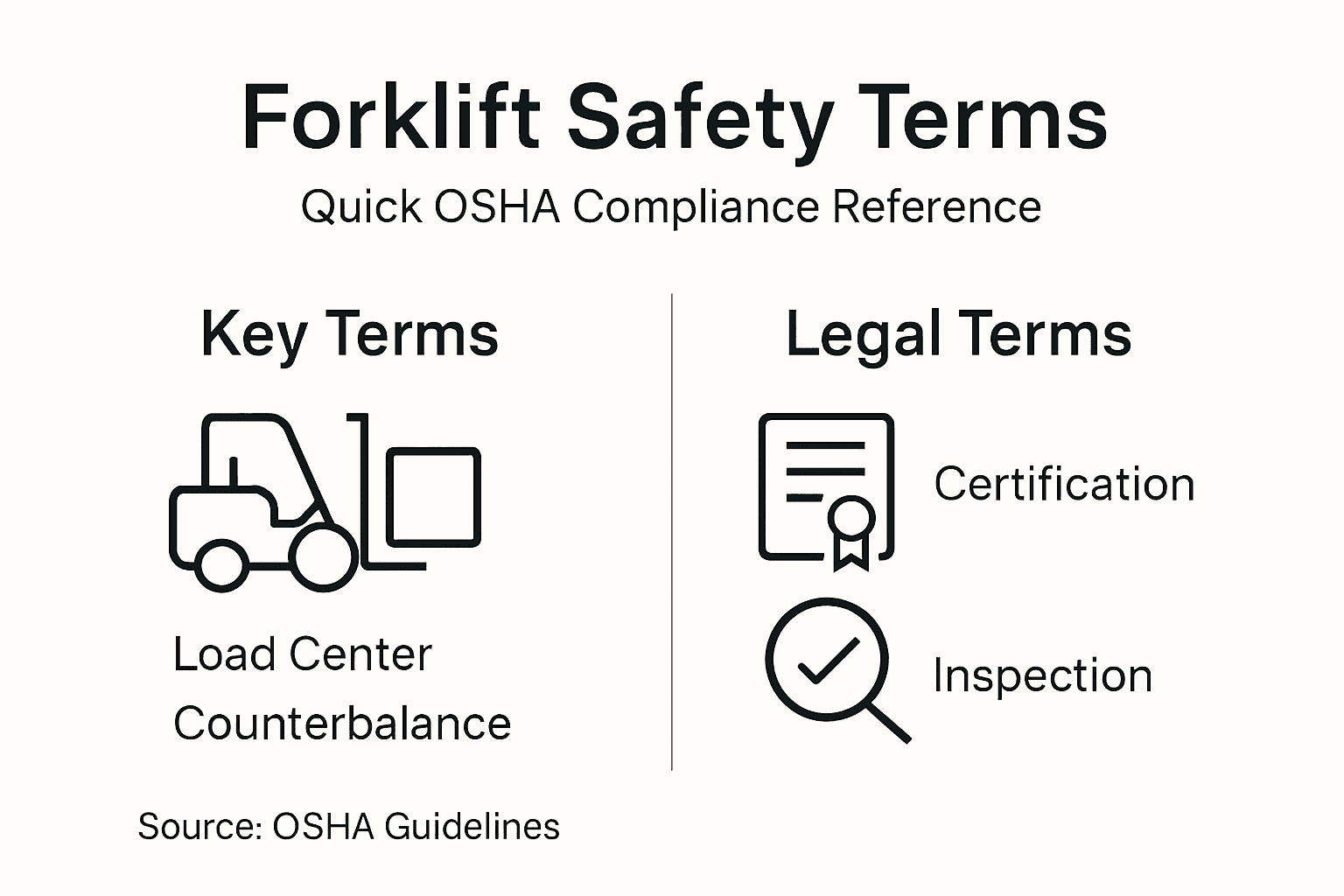
- Load Center: The horizontal distance from the forklift’s vertical load backrest to the load’s center of gravity
- Counterbalance: The weight distributed at the rear of the forklift that prevents tipping during load handling
- Mast: The vertical structure that raises, lowers, and tilts loads
Precise terminology isn’t just about communication – it’s a fundamental safety mechanism that prevents misunderstandings which could lead to catastrophic workplace accidents.
Pro tip: Always verify an operator’s understanding of core forklift terms through standardized assessment techniques to ensure comprehensive safety comprehension.
Types of Forklifts and Classifications
Forklift classifications represent a critical aspect of workplace safety and operational efficiency. OSHA’s comprehensive industrial truck classifications provide essential insights into the diverse range of powered industrial vehicles used across multiple industries. Understanding these classifications helps managers select the right equipment for specific workplace environments.
Forklifts are typically categorized based on several key characteristics, including power source, load capacity, and operational environment. The primary classification types include:
- Electric Motor Forklifts: Ideal for indoor warehouse settings with smooth surfaces
- Internal Combustion Engine Forklifts: Suitable for outdoor and rough terrain applications
- Warehouse Forklifts: Designed for narrow aisle and high-density storage environments
- Rough Terrain Forklifts: Engineered for construction sites and uneven ground conditions
Each forklift type comes with unique operational specifications and safety requirements. Electric forklifts are particularly popular in indoor settings due to their zero-emission performance and quiet operation. In contrast, internal combustion forklifts offer greater mobility and can handle more challenging outdoor work environments.
Not all forklifts are created equal. Selecting the wrong type of forklift can compromise workplace safety and operational efficiency.
Understanding the nuanced differences between forklift types requires careful consideration of several critical factors:
Here’s a concise comparison of main forklift types by workplace suitability and maintenance needs:
| Forklift Type | Best Use Environment | Emission Level | Maintenance Complexity |
|---|---|---|---|
| Electric Motor Forklift | Indoor, smooth floors | Zero emission | Lower, battery focus |
| Internal Combustion Engine | Outdoor, rough terrain | Produces emissions | Higher, engine focus |
| Warehouse Forklift | Tight aisles, storage | Low to zero | Moderate |
| Rough Terrain Forklift | Construction sites | Higher emissions | Frequent, heavy duty |
- Maximum lifting capacity
- Power source and fuel efficiency
- Maneuverability in specific workplace environments
- Terrain compatibility
- Maintenance requirements
Pro tip: Consult with a certified safety professional to match your specific workplace requirements with the most appropriate forklift classification.
Key Features and Operational Terms
Understanding the technical specifications of forklifts requires mastering a complex set of operational terms and safety features. Comprehensive forklift data plate analysis reveals critical information that warehouse managers and operators must comprehend to ensure safe and efficient equipment use.
The most critical operational terms that define a forklift’s performance and safety capabilities include:
- Load Center: The horizontal distance between the load’s center of gravity and the forklift’s front wheel axis
- Stability Triangle: The geometric area formed by the vehicle’s support points that determines its tipping resistance
- Lifting Capacity: The maximum weight a forklift can safely lift and transport
- Mast Height: The vertical reach range of the forklift’s lifting mechanism
Safety features are intrinsically linked to these operational terms. Forklift stability depends on understanding how load distribution, center of mass, and equipment specifications interact. Forklift stability research demonstrates that even slight variations in load placement can dramatically increase accident risks.
Operational terms are not just technical jargon – they are the language of workplace safety and equipment performance.
Warehouse professionals must pay close attention to several key technical specifications:
- Maximum load weight tolerance
- Vertical and horizontal reach capabilities
- Power source and energy efficiency
- Turning radius and maneuverability
- Maintenance requirements and recommended service intervals
Pro tip: Develop a standardized checklist that systematically reviews each critical operational term before every forklift operation to minimize safety risks.
OSHA Training, Certification, and Legal Terms
OSHA’s comprehensive industrial truck training requirements establish critical legal standards for forklift operation and workplace safety. Understanding these regulations is essential for businesses seeking to maintain compliance and protect their workforce from potential accidents and legal liabilities.
The core legal terms and certification requirements for forklift operators include:
- Formal Training: Mandatory classroom instruction covering equipment-specific safety protocols
- Practical Evaluation: Hands-on performance assessment demonstrating operational competence
- Certification Documentation: Official records proving successful completion of training
- Periodic Recertification: Required refresher courses every three years or after significant workplace incidents
Operator responsibilities extend far beyond simply understanding equipment controls. Employers must maintain detailed documentation that demonstrates comprehensive safety training, including:
- Written training records
- Performance evaluation results
- Equipment-specific qualification certificates
- Individual operator safety assessments
Legal compliance is not optional – it’s a fundamental requirement for protecting workers and avoiding significant financial penalties.
The most critical legal terms warehouse managers must understand involve:
- Employer training obligations
- Operator qualification standards
- Documentation retention requirements
- Incident reporting protocols
- Disciplinary actions for non-compliance
Pro tip: Develop a standardized tracking system that monitors individual operator certifications, ensuring no training expiration goes unnoticed.
This table summarizes essential operator certification steps and legal obligations:
| Requirement | Purpose | Typical Frequency |
|---|---|---|
| Formal Training | Ensure safety knowledge | Once, onboarding |
| Practical Evaluation | Assess operating skills | Initially and recertify |
| Documentation | Legal compliance proof | Ongoing, after training |
| Recertification | Refresh safety standards | Every 3 years |
Common Mistakes and Risk Prevention
Forklift safety guidelines reveal that most workplace accidents result from preventable operational errors. Understanding these common mistakes is crucial for creating a comprehensive risk management strategy that protects both operators and workplace personnel.
The most frequent and dangerous forklift operational mistakes include:
- Inadequate Pre-Shift Inspections: Skipping critical equipment checks
- Overloading: Exceeding recommended weight capacities
- Improper Load Stabilization: Failing to secure loads correctly
- Distracted Operation: Using mobile devices or engaging in non-essential communication
- Insufficient Training: Allowing unqualified personnel to operate equipment
Risk prevention requires a multifaceted approach that addresses both human behavior and equipment management. Warehouse managers must implement comprehensive strategies that go beyond basic training, including:
- Mandatory daily equipment inspections
- Regular skills reassessment
- Clear communication protocols
- Strict enforcement of safety standards
- Continuous operator education
A single overlooked safety protocol can transform a routine operation into a potential catastrophe.
Critical risk mitigation strategies focus on:
- Developing robust safety culture
- Implementing real-time monitoring systems
- Creating consequence-based safety protocols
- Conducting regular risk assessments
- Maintaining detailed incident reporting mechanisms
Pro tip: Establish a confidential near-miss reporting system that encourages operators to share potential safety concerns without fear of retribution.
Master Forklift Terminology and Achieve OSHA Compliance with Ease
Understanding forklift terminology and operational safety is essential to preventing costly mistakes and workplace accidents. This article highlights critical terms like load center, stability triangle, and lifting capacity that every operator must know to stay compliant and safe. If you are striving to eliminate misconceptions and strengthen your team’s OSHA knowledge, targeted training is the key.
Unlock the power of professional instruction with Forklift Safety Archives – Top OSHA Forklift Certification that can help you translate complex terminology into practical skills.
Take control of safety and compliance today by exploring our OSHA-approved forklift training and certification options at Forkliftacademy.com. Whether you need individual online courses or comprehensive onsite business solutions, acting now will protect your workforce and enhance operational efficiency. Start mastering forklift language and safe operation with trusted training designed for your success. Learn more about certification and stay ahead by visiting our Forklift License Archives.
Frequently Asked Questions
What are the key terms I need to understand when operating a forklift?
Understanding forklift terminology includes key terms like Load Center, Counterbalance, and Mast. These terms are fundamental for ensuring safe operation and compliance with OSHA regulations.
How can I prevent misunderstandings about forklift lifting capacity?
To prevent misunderstandings, always communicate the maximum lifting capacity accurately. Operators should understand the load’s size and weight distribution, and training should emphasize the importance of adhering to specified limits.
What common misconceptions about forklift stability should operators be aware of?
One common misconception is that all forklifts have the same stability characteristics. In fact, different forklifts can behave differently depending on the terrain and load configurations, making it essential to understand the specific equipment being used.
How can I ensure compliance with OSHA training requirements for forklift operators?
Ensure compliance by providing formal training that covers safety protocols, conducting practical evaluations to assess skills, and maintaining thorough documentation of training and performance evaluations.
Recommended
- Forklift Training Terminology Explained: Safety and Compliance – Top Osha Forklift Certification
- Forklift Safety Terminology Explained: Enhancing OSHA Training – Top Osha Forklift Certification
- Complete Guide to OSHA Compliance for Forklift Safety – Top Osha Forklift Certification
- Forklift Safety Standards Explained: OSHA Rules and Compliance – Top Osha Forklift Certification