
Every year, more than 1,000 American workers are injured in scissor lift accidents due to overlooked site conditions and improper equipment checks. For warehouse and logistics managers, ensuring that every new operator completes OSHA-compliant training is not just a regulation, but a critical safeguard for your team and business. This guide breaks down each step to assess your job site, master safe lift techniques, and maintain reliable certification for truly effective American workplace safety.
Table of Contents
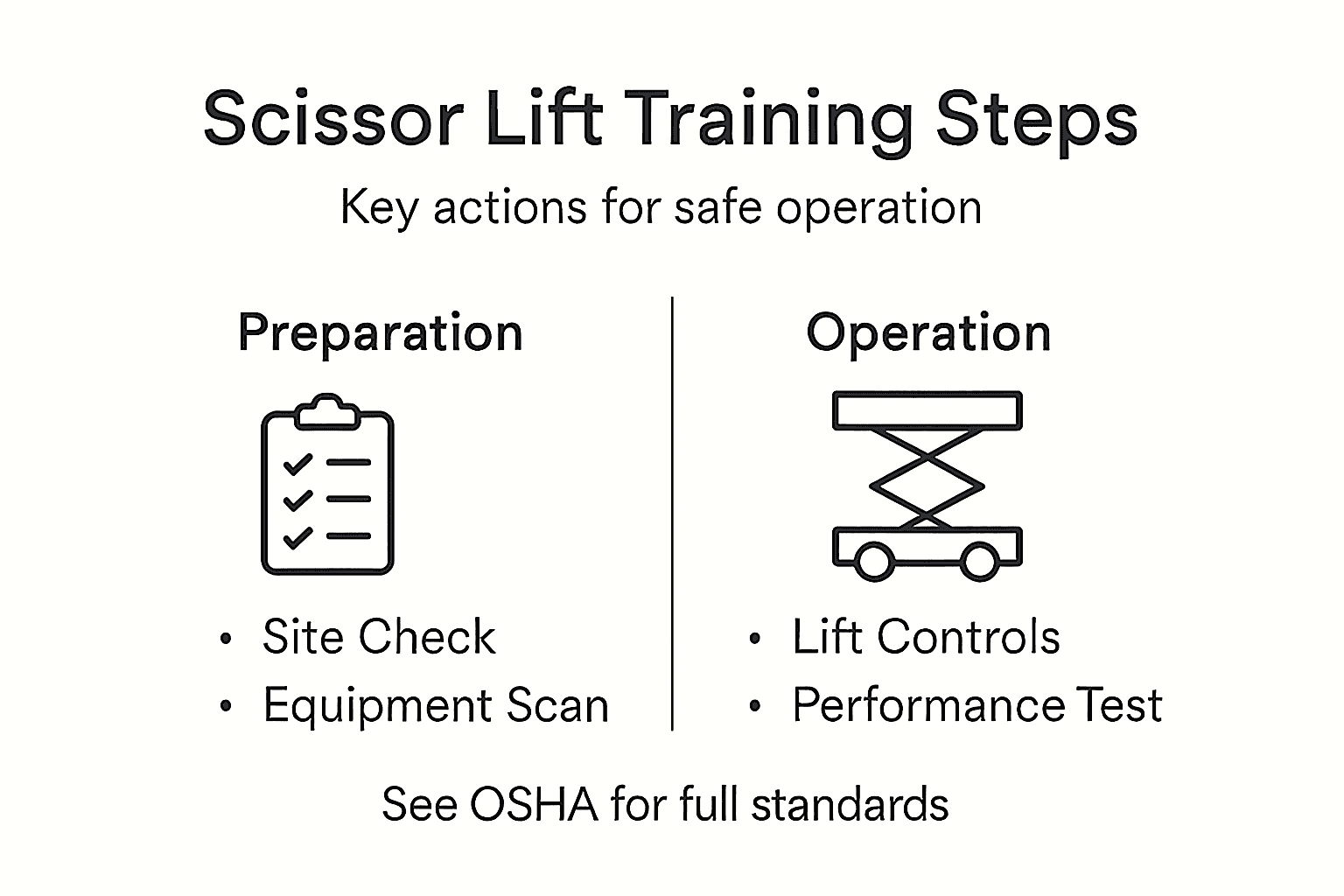
- Step 1: Assess Equipment And Job Site Conditions
- Step 2: Review OSHA Requirements And Safety Checks
- Step 3: Demonstrate Proper Scissor Lift Operation
- Step 4: Practice Hands-On Maneuvering And Controls
- Step 5: Verify Operator Performance And Certification
Quick Summary
| Key Point | Explanation |
|---|---|
| 1. Conduct a thorough site assessment | Evaluate ground stability and obstacles to ensure safe lift operation. |
| 2. Familiarize yourself with OSHA standards | Understand specific safety regulations that govern scissor lift use. |
| 3. Practice safe operating techniques | Master control movements and maintain awareness of surroundings while operating. |
| 4. Engage in hands-on training | Develop practical skills through real-world scenarios and drill exercises. |
| 5. Obtain and maintain certification | Undergo rigorous evaluations to validate skills and ensure compliance with safety protocols. |
Step 1: Assess equipment and job site conditions
Before you start operating a scissor lift, a comprehensive site and equipment assessment is your first critical safety checkpoint. This crucial step involves evaluating multiple environmental and mechanical factors to prevent potential accidents and ensure smooth, safe operations.
Begin by conducting a thorough visual inspection of the entire work area. Look for potential obstacles such as uneven ground surfaces, overhead obstructions like electrical lines or structural beams, and any environmental conditions that might compromise lift stability. Check the ground carefully – you want a firm, level surface without soft spots, slopes, or loose materials that could cause tipping. Verify the terrain can support the scissor lift’s weight distribution and won’t shift or collapse under operational stress.
Next, examine the scissor lift itself. Inspect all components including guardrails, controls, hydraulic systems, and safety mechanisms. Confirm that maintenance records are current and the equipment is in proper working condition. Pay special attention to tire condition, structural integrity, and operational controls. Verify proper equipment specifications match the specific job requirements and site constraints.
Pro tip: Create a standardized pre operation checklist with clear visual indicators to ensure you consistently perform a comprehensive equipment and site assessment every single time.
Here is a summary of key considerations for a safe scissor lift assessment:
| Assessment Focus | What to Check | Why It Matters |
|---|---|---|
| Ground Conditions | Firm, level, stable ground | Prevents lift tipping or sinking |
| Overhead Obstacles | Power lines, ceiling beams | Avoids collision risk |
| Equipment Components | Guardrails, tires, controls | Ensures mechanical reliability |
| Maintenance Records | Inspection log current | Confirms safe operating history |
Step 2: Review OSHA requirements and safety checks
Operating a scissor lift requires a comprehensive understanding of OSHA safety standards to protect yourself and your team. Your goal in this step is to thoroughly review and internalize the critical regulatory requirements that govern scissor lift operations.
Start by familiarizing yourself with specific OSHA scaffold standards that apply to scissor lifts. These regulations classify scissor lifts as mobile scaffolds and mandate specific safety protocols. Key areas of focus include fall protection requirements, guardrail specifications, and detailed operational guidelines outlined in standards 29 CFR 1926.451 and 1926.452. Pay special attention to employer responsibilities such as routine safety inspections, comprehensive worker training, and maintaining equipment according to manufacturer guidelines.
Carefully review the personal protective equipment requirements and fall protection systems. OSHA interpretation clarifies that operators must use personal fall arrest systems when necessary and ensure all safety mechanisms are functional and properly installed. This includes checking guardrails, harness attachments, and understanding the specific fall hazard mitigation strategies for your particular work environment.
Pro tip: Create a laminated OSHA compliance quick reference card that you can carry with you during operations to instantly verify key safety requirements and standards.
This table highlights key differences between OSHA requirements and best practice recommendations for scissor lift safety:
| Safety Area | OSHA Requirement | Best Practice Enhancement |
|---|---|---|
| Fall Protection | Guardrails or harness as required | Use harness plus guardrail combination |
| Pre-Use Inspection | Employer mandatory | Operator daily self-checklist |
| Training | Formal and documented | Regular hands-on retraining |
| Certification Renewal | When equipment/worksite changes | Annually or more frequently |
Step 3: Demonstrate proper scissor lift operation
Now that you understand the safety requirements, it is time to put your knowledge into practice by mastering the precise techniques for operating a scissor lift safely and efficiently. This step focuses on translating theoretical knowledge into skilled, controlled movement.
Begin by understanding the mechanical function of the scissor lift. These machines operate through a unique crossed support system that allows vertical movement. Always start by positioning yourself correctly on the platform floor with stable footing. Ensure you maintain three points of contact when moving around, keep your body centered, and never lean over the guardrails. Control the lift using clearly marked controls, making smooth and deliberate movements. Critical rules include never moving the lift while elevated unless specifically designed for that purpose and strictly adhering to the manufacturer’s recommended load capacities.

Maintain constant awareness of your surrounding environment during operation. Safe scissor lift operation requires avoiding side forces that could destabilize the platform, monitoring overhead clearances, and keeping the work area clear of potential obstacles. Practice smooth acceleration and deceleration, and always communicate with ground personnel about your movements and intentions.
Pro tip: Practice scissor lift operations in a controlled environment before performing actual work tasks to build muscle memory and confidence in your movement techniques.
Step 4: Practice hands-on maneuvering and controls
With safety knowledge and basic operational understanding in place, it is time to develop practical skills through structured hands-on training. This critical stage transforms theoretical knowledge into muscle memory and confident scissor lift operation.
Hands-on training exercises are designed to help you master precise platform movement, terrain navigation, and emergency control procedures. Start by familiarizing yourself with the control panel, identifying each lever and button’s specific function. Practice smooth acceleration and deceleration, focusing on maintaining stable platform positioning. Learn to interpret control responses, understanding how slight movements translate into lift behavior. Pay special attention to emergency stop mechanisms and practice quick response techniques for unexpected situations.
Practical operator training involves simulating real world scenarios across different surfaces. Begin with level ground, then progress to slightly uneven terrain to build confidence and skill. Practice smooth turning, precise positioning, and maintaining situational awareness. Learn to recognize potential hazards quickly and respond with controlled, deliberate movements. Remember that smooth operation comes from understanding the lift’s mechanical limitations and your own physical capabilities.
Pro tip: Record your practice sessions on video to analyze your technique and identify areas for improvement in your scissor lift maneuvering skills.
Step 5: Verify operator performance and certification
The final stage of scissor lift training involves rigorous performance evaluation and official certification to ensure you meet all safety and operational standards. This critical step transforms your training into recognized professional competency.
OSHA operator certification requirements mandate comprehensive verification of an operator’s skills and knowledge. Your employer will conduct a detailed assessment that includes both theoretical understanding and practical demonstration of scissor lift operation. This evaluation covers your ability to inspect equipment, navigate different terrains, respond to emergency situations, and maintain workplace safety protocols. Expect to be observed performing various maneuvers and scenarios that test your technical skills and decision making under potential work conditions.
Employer training verification involves documenting your competency through written records, practical testing, and potentially video documentation of your performance. You will need to demonstrate proficiency in classroom instruction components as well as hands-on equipment handling. Certification is not a one time event but an ongoing process that requires periodic reassessment, especially when equipment changes or workplace conditions evolve.
Pro tip: Maintain a personal log of your training sessions and certifications to track your professional development and demonstrate your commitment to workplace safety.
Elevate Your Safety with Expert Scissor Lift Training
Operating a scissor lift safely requires more than just basic knowledge. This article highlights the critical need for a thorough site assessment, mastery of OSHA requirements, hands-on control practice, and official certification. If you want to overcome challenges like equipment inspection, fall protection compliance, and confident maneuvering, professional guidance is essential. At Forkliftacademy.com, we specialize in delivering OSHA-compliant training designed to build your skills and keep you safe on the job.
Ready to take your scissor lift operation to the next level? Explore our comprehensive Forklift Certification Archives for expert courses tailored to your needs. Discover safety best practices in our Forklift Safety Archives. Start your path toward certified, confident operation today by visiting Forkliftacademy.com. Don’t wait until safety becomes a risk; act now and secure your certification with trusted industry leaders.
Frequently Asked Questions
What are the key steps in scissor lift training for safe operation?
Begin by assessing the equipment and job site conditions, reviewing OSHA requirements, and demonstrating proper operation techniques. Then, practice hands-on maneuvering and verify your performance through certification.
How can I assess the ground conditions before using a scissor lift?
Inspect the ground for stability, looking for firm and level surfaces without soft spots or slopes. Ensure that the terrain can support the lift’s weight and reduce the risk of tipping during operation.
What are the OSHA requirements I need to know for operating a scissor lift?
Familiarize yourself with OSHA scaffold standards that specify fall protection, guardrail specifications, and operational guidelines. Adhere to employer responsibilities for routine safety inspections and ensure all safety mechanisms are functional.
What should I prioritize during the pre-operation inspection of a scissor lift?
Focus on checking ground conditions, equipment components, and maintenance records. Ensure the scissor lift’s guardrails, controls, and hydraulic systems are all functional and up-to-date before starting operations.
How can I practice effective maneuvering of a scissor lift?
Engage in hands-on training exercises that focus on understanding the control panel, practicing acceleration and deceleration, and navigating various terrains. Implement smooth movements and maintain situational awareness during practice sessions.
What does the certification process for scissor lift operators entail?
The certification process involves demonstrating both theoretical knowledge and practical operation skills. Expect to be evaluated by your employer on various scenarios and maintain documentation of your training and competency.
Recommended
- Essential Scissor Lift Training Steps for Safe Operations – Top Osha Forklift Certification
- 7 Essential Tips for a Complete Scissor Lift Safety List – Top Osha Forklift Certification
- 7 Key Steps in a Scissor Lift Training Checklist for Safety – Top Osha Forklift Certification
- 7 Key Scissor Lift Training Essentials for Beginners – Top Osha Forklift Certification