
Most American warehouses face one stubborn truth: untrained forklift operators cause more than 30,000 serious injuries each year. For warehouse managers and compliance officers, meeting OSHA forklift certification standards is more than a box to check. It means protecting staff, reducing costly accidents, and keeping operations running smoothly under ever-tightening regulations. This guide exposes the biggest myths around forklift certification and breaks down exactly what compliance means for workplace safety and your bottom line.
Table of Contents
- Defining Forklift Certification And Common Myths
- OSHA Forklift Regulations And Legal Responsibilities
- Certification Process: Training, Testing, And Renewal
- Safety Outcomes And Reduced Accident Risks
- Employer Liabilities, Penalties, And Cost Savings
Key Takeaways
| Point | Details |
|---|---|
| Importance of Certification | Forklift certification is essential for worker safety and legal compliance, encompassing detailed training beyond basic operations. |
| Misconceptions About Training | Common myths, like previous experience sufficing for certification, are false; structured training is mandatory. |
| Employer Responsibilities | Employers must maintain certification records, conduct training, and ensure compliance with OSHA regulations to avoid legal penalties. |
| Cost-Benefit of Certification | Investing in comprehensive training programs can significantly reduce accidents, insurance costs, and potential liabilities. |
Defining Forklift Certification and Common Myths
Forklift certification is a critical safety requirement that goes far beyond simply learning how to operate machinery. It represents a comprehensive training process designed to protect workers and ensure safe warehouse operations. Proper forklift certification confirms an operator’s knowledge of safety protocols, equipment controls, and potential workplace hazards.
Unlike popular misconceptions, forklift certification is not a simple task anyone can complete quickly. The process involves rigorous classroom instruction, hands-on practical training, and a detailed workplace evaluation that tests an operator’s competency in real-world scenarios. Operators must demonstrate understanding of critical safety elements including pedestrian awareness, load management, equipment inspection, and site-specific operational challenges.
Common myths about forklift certification persist despite clear OSHA regulations. Many warehouse workers mistakenly believe that prior experience or informal training qualifies them to operate these powerful machines. However, professional certification requires structured learning that covers specific safety standards. Key certification components include understanding mechanical controls, recognizing potential workplace risks, proper load handling techniques, and mastering safe maneuvering strategies in complex industrial environments.
Here’s how major forklift certification myths compare to reality:
| Myth | Reality | Business Impact |
|---|---|---|
| Experience is enough | Formal training required | Reduces accident risk |
| Certification is quick | In-depth process | Ensures thorough safety skills |
| Informal training counts | Only accredited programs valid | Maintains legal compliance |
| One-time certification | Recertification needed | Keeps operators current |
Pro tip: Always verify an operator’s official certification documents and ensure they have been trained within the last three years, as OSHA recommends periodic recertification to maintain current safety standards.
OSHA Forklift Regulations and Legal Responsibilities
The legal landscape surrounding forklift operations is complex and stringent, with comprehensive OSHA regulations establishing clear requirements for workplace safety. Under 29 CFR 1910.178, employers bear significant legal responsibility for ensuring that forklift operations meet precise safety standards, equipment maintenance protocols, and operator training requirements. These regulations are not merely recommendations but legally enforceable mandates designed to protect workers and prevent potentially catastrophic workplace accidents.
Employers must navigate a detailed framework of legal obligations that extend far beyond simple training. This includes conducting thorough operator assessments, maintaining equipment to manufacturer specifications, documenting certification processes, and implementing workplace safety protocols specific to forklift operations. Violations can result in substantial financial penalties, potential legal action, and increased workplace insurance costs. The regulations mandate that every forklift operator must be formally certified, demonstrating competency in equipment operation, safety procedures, and potential hazard recognition.
The federal regulatory framework places explicit responsibilities on employers to prevent workplace accidents. Specific legal requirements prohibit equipment modifications without manufacturer approval, require periodic equipment inspections, and mandate comprehensive operator training programs. These regulations recognize that forklift operations represent a significant workplace risk, necessitating a proactive approach to safety management that goes well beyond basic operational training.
This table summarizes key employer responsibilities under OSHA forklift regulations:
| Responsibility | Description | Consequence if Neglected |
|---|---|---|
| Certify operators | Ensure all operators are trained and certified | Fines, increased liability |
| Maintain records | Track training, certification, and equipment logs | Poor compliance evidence |
| Inspect equipment | Perform regular checks and follow manufacturer guidelines | Dangerous equipment failure |
| Prevent modifications | Disallow unauthorized equipment changes | Legal penalties and risk |
Pro tip: Maintain meticulous documentation of all forklift operator certifications, training records, and equipment maintenance logs to demonstrate compliance and protect your organization from potential legal and financial risks.
Certification Process: Training, Testing, and Renewal
The forklift certification process is a comprehensive journey that demands rigorous preparation and ongoing commitment. OSHA training requirements mandate a multilayered approach that goes beyond basic operational instruction. The process typically involves three critical stages: classroom learning, practical hands-on training, and workplace performance evaluation, each designed to ensure operators possess the skills and knowledge necessary for safe forklift operation.
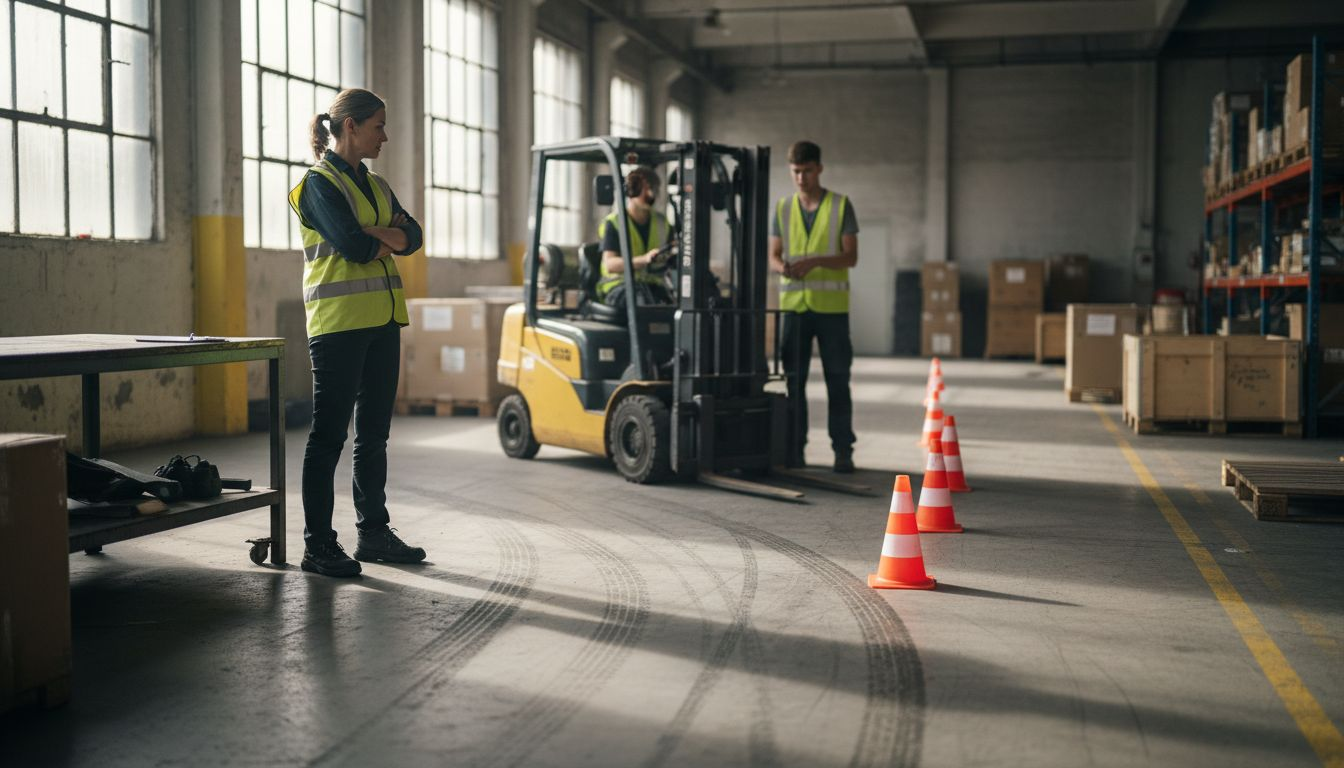
Classroom instruction forms the foundational component of certification, covering theoretical aspects of forklift operation, safety protocols, and potential workplace hazards. Operators must demonstrate comprehensive understanding of equipment mechanics, load management principles, workplace navigation strategies, and emergency response procedures. Following classroom training, candidates progress to hands-on practical training, where they apply theoretical knowledge in controlled environments. This stage involves supervised equipment operation, demonstrating proficiency in maneuvering techniques, load handling, spatial awareness, and adherence to safety protocols.
The final and most critical stage involves workplace performance evaluation, where operators are assessed in their actual working environment. Employers must document this evaluation, recording the operator’s name, trainer’s credentials, and specific training dates. According to regulatory guidelines, certification is not a one-time event but a recurring process. Recertification is mandatory every three years, or sooner if an operator demonstrates unsafe behavior, experiences an accident, or encounters significant workplace changes that impact operational safety. This approach ensures continuous skill maintenance and adaptation to evolving workplace dynamics.
Pro tip: Implement a proactive tracking system for certification expiration dates and schedule refresher training at least 30 days before certification lapses to maintain uninterrupted operational compliance.
Safety Outcomes and Reduced Accident Risks
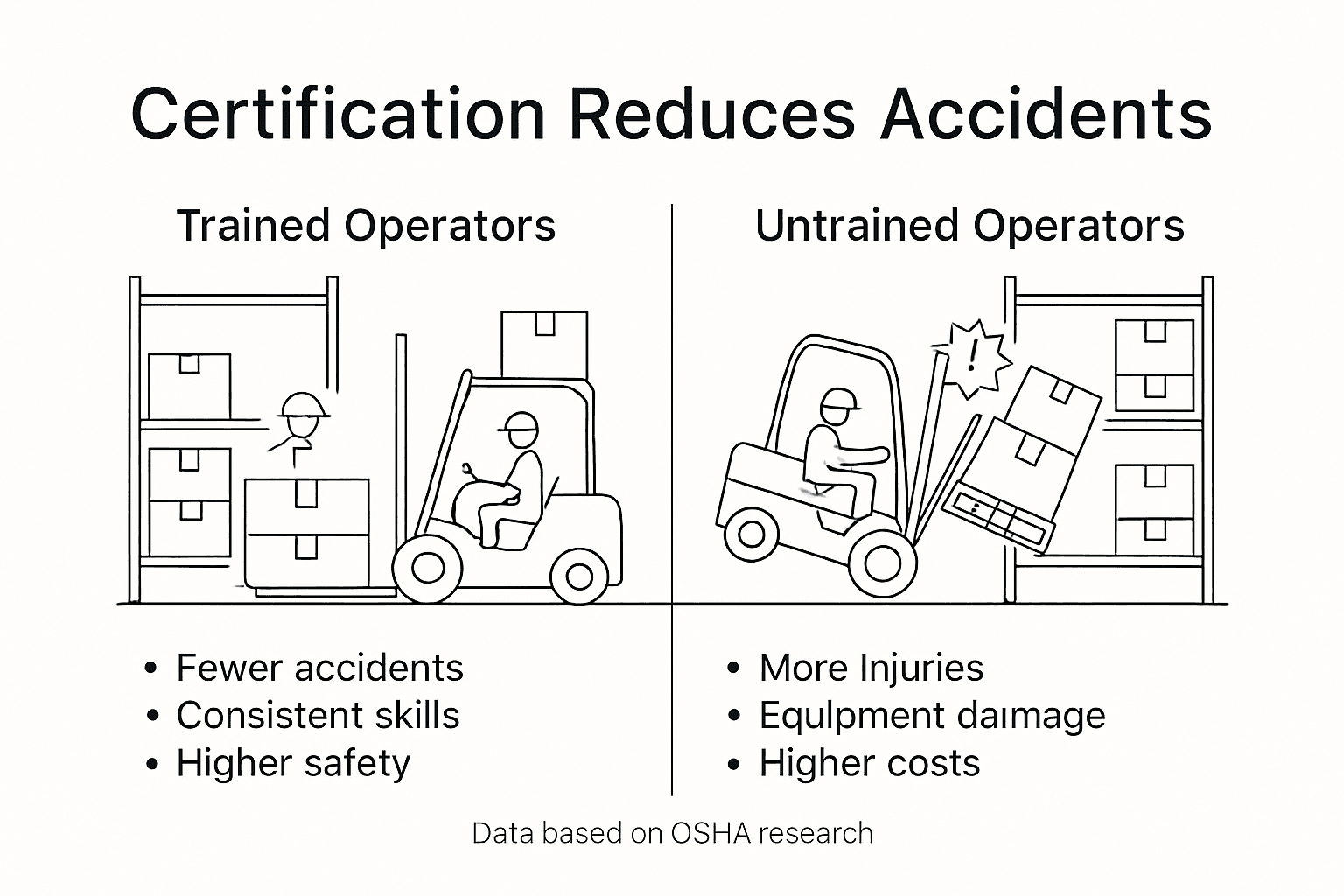
Comprehensive forklift safety data reveals that proper certification dramatically reduces workplace accidents by transforming operators from potential liability risks to safety-conscious professionals. Forklift accidents represent a significant hazard in warehouse and industrial environments, with untrained operators creating substantial risks to themselves and their coworkers. Certification programs systematically address these risks by developing critical skills in hazard recognition, equipment control, and proactive safety management.
The training process targets specific accident scenarios that frequently result in injuries and equipment damage. Operators learn advanced techniques for managing complex situations like navigating tight spaces, handling unstable loads, maintaining appropriate speeds, and understanding center of gravity principles. These skills directly translate to measurable safety improvements, teaching operators to anticipate potential risks before they become dangerous incidents. By emphasizing situational awareness and precise equipment handling, certification programs create a fundamental shift in how workers approach industrial vehicle operation.
Statistical evidence powerfully demonstrates the impact of comprehensive forklift training. Safety research from OSHA indicates that certified operators experience significantly lower accident rates compared to untrained workers. Key safety improvements include more consistent use of safety equipment like seatbelts, strict adherence to load weight limits, enhanced pedestrian awareness, and a more disciplined approach to equipment operation. These behavioral changes represent a holistic approach to workplace safety that extends beyond individual skill development to create a broader culture of risk prevention and responsible equipment management.
Pro tip: Conduct quarterly safety refresher sessions that review recent accident data and reinforce key certification training principles to maintain ongoing operator awareness and skill retention.
Employer Liabilities, Penalties, and Cost Savings
OSHA penalty structures reveal the substantial financial risks employers face when neglecting forklift safety compliance. A single violation can result in fines reaching up to $165,514, transforming what seems like a routine training expense into a critical financial protection strategy. These penalties are not merely punitive but designed to compel employers to prioritize workplace safety and invest in comprehensive operator training programs that prevent accidents and protect workers.
The legal landscape surrounding forklift operations is complex and unforgiving. Employers bear direct responsibility for any accidents caused by untrained or improperly certified operators. Beyond immediate financial penalties, companies face potential litigation, increased insurance premiums, workers compensation claims, and potential criminal charges in cases of severe negligence. The financial implications extend far beyond the initial penalty, potentially threatening an organization’s entire operational stability and reputation in the industry.
Proactive certification programs represent a strategic investment in risk management. Legal frameworks under OSHA demonstrate that employers who implement robust training protocols can significantly mitigate potential financial risks. Cost savings emerge through multiple channels: reduced accident rates, lower insurance premiums, decreased equipment damage, minimized legal exposure, and enhanced overall workplace productivity. By treating forklift certification as a critical business strategy rather than a compliance checkbox, organizations can transform potential liability into a competitive advantage.
Pro tip: Develop a comprehensive tracking system that monitors certification expiration dates, training completion, and individual operator performance to proactively manage compliance and minimize potential penalty risks.
Ensure Warehouse Safety with Trusted Forklift Certification Solutions
Warehouse safety cannot be compromised when OSHA regulations require thorough forklift certification for every operator. This article highlights the critical need to go beyond informal training and myths about quick certification. If you want to reduce accident risks, meet legal responsibilities, and maintain ongoing compliance through effective recertification, you need a provider that understands these challenges deeply.
At Forkliftacademy.com, we specialize in delivering fully OSHA-compliant forklift certification programs tailored to meet your safety and operational goals. Whether you seek individual training or comprehensive onsite business solutions, our platform offers well-structured courses including evaluation-only options and train-the-trainer kits. Start building a safer workplace today by exploring our Forklift Certification Archives and learn how our expert programs can help you stay ahead of legal obligations. Visit Forkliftacademy now and take the first step to protect your team and your business from costly penalties and accidents. For insights on advancing your career or training approach, check out our Career Archives.
Frequently Asked Questions
What is forklift certification?
Forklift certification is a comprehensive training process that ensures operators understand safety protocols, equipment controls, and workplace hazards associated with operating forklifts.
Why is forklift certification important for warehouse safety?
Forklift certification is crucial for improving safety in warehouses as it significantly reduces the risk of accidents by ensuring operators are trained in safe handling, equipment management, and hazard recognition.
How often do forklift operators need to be recertified?
Forklift operators must be recertified every three years, or sooner if they demonstrate unsafe behavior, are involved in an accident, or if there are significant workplace changes affecting safety.
What are the consequences of not having certified forklift operators?
Not having certified forklift operators can lead to substantial financial penalties, increased liability, potential legal action, and a heightened risk of workplace accidents that can harm employees and damage assets.
Recommended
- Understanding Forklift Certification Explained for Operators – Top Osha Forklift Certification
- Role of Training in Warehouse Safety: Preventing Accidents and Ensuring Compliance – Top Osha Forklift Certification
- Forklift Safety Standards Explained: OSHA Rules and Compliance – Top Osha Forklift Certification
- Is Being Forklift Certified a Big Deal? – Top Osha Forklift Certification